This manifesto was originally writen for a spirit house project[1]. I have since branched out, but I can either photograph or rewrite, and so....
* * *
Thai material culture is highly modular, a kaleidoscope of blue pipes, red plastic chairs, golden amulets, brown bottles of energy drinks, green leaves, pink Bougainvillea, white cats, black mold[1]. Thailand is still colorful, unlike the greying West[2]. Through the viewfinder -- especially to a photographer with bad eyesight -- Thailand is like a mosaic at the Grand Palace, or like the flattened surfaces of the Cubists and the Nabis.
Transforming that mosaic into images is my goal as a photographer. As a corollary to the main concept: I feel that every bit or byte of the photo from front to back should, ideally, yield something of interest and please the eye, especially the reminiscent eye, in the photograph as well is in reality. Hence my default workflow includes a small aperture, a low ISO, and long exposures. Ideally the tension or structure of the photo -- which is not the same as the subject -- should extend to every edge of the frame. When using a tripod, I am doing street photography, but with a decisive moment that is thirty seconds long.
I started photographing in the United States with an iPad, taking pictures of my garden so I could write about them in my blog. When I moved to Bangkok, I decided I needed a project, and that I would learn to photograph seriously, with a serious camera. I was inspired by Peter Nitsche's wonderful photobook Shophouses. Looking around for a suitable subject to create a series of "still life portraits" of my own, Spirit Houses sprang immediately to my eye [3].
Recently, I've branched out from Spirit Houses[4] into other aspects of Thai material culture, partly because I have run out of Spirit Houses within walking distance, but more because I want to step back and focus on wider contexts as a photographer, especially the Thailand streetscape of workers, small masters, food cart ladies, etc.
I cannot express how lucky I feel at having been able to make a life in Bangkok. In some ways this project is paying it forward: I am documenting a world that may vanish for future historians, if any.
Things That Are Not OK
1) NO SENTIMENTALITY. "Everybody hates a tourist." I do not personally believe in the "Family of Man" concept at all; at the best, I find it intrusive. (Blur, a consequence of my workflow, is my friend here; I photograph typical bodily motions and employments, even as individuals, but not as portraits.) If I were photographing a village in which I had lived for a long time, it might be different; but such is not the case for me now.
2) NO FORCING. I am very online. I process enormous quantities of propaganda, much of it visual. The constant pounding of manipulation is exhausting. I do not wish to have my eye dragged around the frame and then have my heart tugged at. My first mentor told me that he wished to "make the eye dance." I would prefer to allow the eye to caress, and that as slowly as possible. (Of course, I am also making immediate use of all of LightRoom's new masking features to bring out the colors and objects I choose from the mosaic before me. I tell myself I am just bringing out what I really saw in the first place, the reason I took the photo.)
3. BOKEH. Obviously.
Things That Are OK
1) Subjects that are not immediately obvious.
2) Subjects that are relations and not objects.
3) Literary features like jokes and puzzles, or symbolism.
Also, titles and captions are part of the work, and not add-ons to it.
NOTES
[1] The photo book to look at here is Philip Cornwel-Smith's famous Very Thai.
[2] From a study of over 7,000 objects in the UK’s Science Museum:
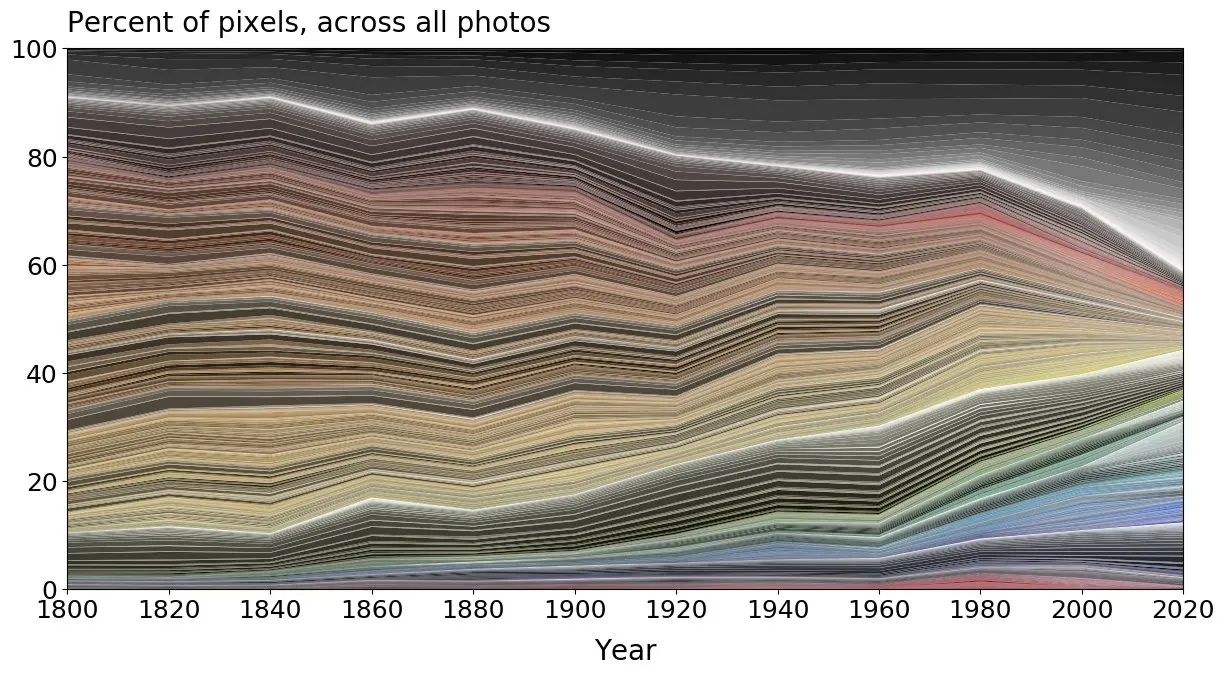
This is not Thailand, and especially not lo-so Thailand.
[3] This series be published on this site, in three volumes of 99 photos each, when I solve a data recovery problem (and have the time)
[4] Thai spirit houses share the same modular characteristics as the rest of Thai material culture; they are one and all "same same but different." Additionally, Thai spirit houses are always minded -- or not minded -- by people, so they partake of personal circumstances of the minders, plus the animist, syncretic, and pragmatic character of Thai spirituality, at least as I perceive it. (There are actually services that clean and refresh the spirit houses for malls, gas stattions, and condos. Spirit houses are alsos sold in Thai home and garden shops.) Thai spirit houses are also, like Thailand itself and even more Bangkok, very dynamic. The "spirits of the land" change their form, driven by real estate development, for example.
Many, many years ago, when my camera was an ancient Leica I bought at pawn shop in CentralSquare, Cambridge MA, I undertook a similar project on film: Bathtub madonnas in Somerville. Apparently, there is something deep within me that seeks out colorful icons of popular religion or spirituality. I do think I am a better photographer now than I was then.